
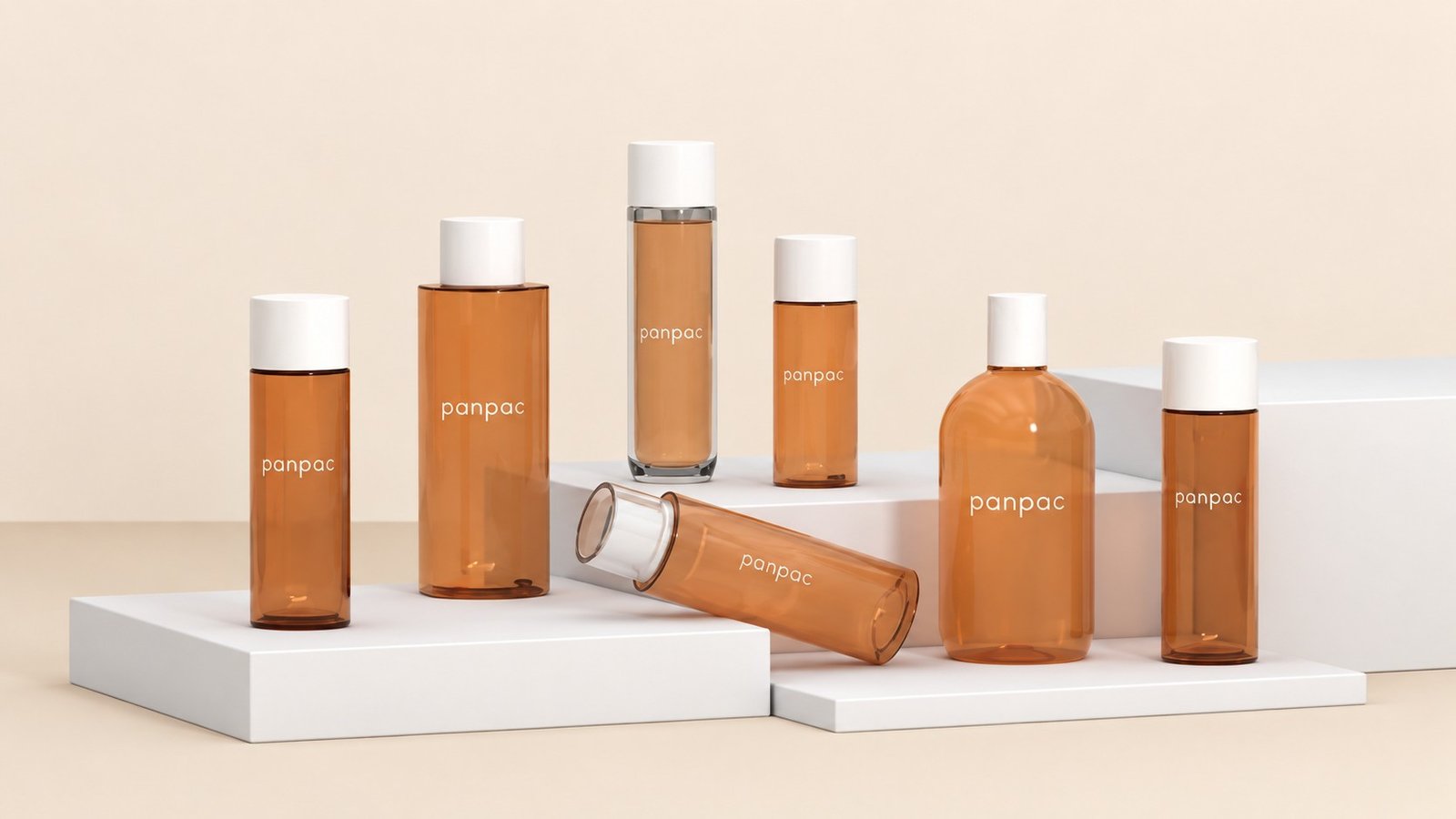
Custom Amber Toner Bottle Range for Facial Toner and Cleansing Water
A broad amber bottle range for everyday liquid skincare. Catalogue reference PAN-SC-017.
Explore this collection →Personal care packaging / PAN-SC-016
Green bottle formats for oil and fluid skincare ranges

Collection reference: PAN-SC-016. Final components and custom options are confirmed for your project.
This collection includes green bottle profiles with different pump and spout presentations. It can form a coordinated facial oil, body oil or serum range, subject to formula and dispenser review. PANPAC can match the visual identity without assuming every oil blend behaves like a water-based lotion.
Build the collection around the formulas. The pictured catalogue direction is a starting point for custom development, not a guarantee that every capacity, material and closure is interchangeable. Share the products you plan to launch together so PANPAC can separate the existing reference from any new matching component.
| Catalogue reference | PAN-SC-016 |
|---|---|
| Website SKU | PP-PC-SET-036 |
| Collection scope | Empty packaging; coordinated matching formats reviewed per project |
| Catalogue capacity options | 100, 120, 150, 180 ml |
| Material specification | Bottle and dispenser contact materials to be confirmed |
| Custom development | Bottle profile, capacity, colour, closure and decoration subject to component, tooling and sample approval |
| Dispensing structure | Confirm the exact closure, pump or sprayer; foaming and airless extensions require separately approved assemblies |
| Order quantities and lead time | Quoted after confirming formats, colours, decoration, quantities per SKU and sample scope |
Need another visual direction? Compare pink black skincare bottle set. For a broader purchasing brief, review amber tone skincare packaging set alongside this collection, then identify the formats you actually need rather than ordering a decorative set with unsuitable dispensers.
Oil blends and fragrance-containing formulas may behave differently with seals, dip tubes and decorated surfaces. Review the proposed wetted components and test the finished formulation in the assembled pack. For Middle Eastern and European buyers sourcing botanical-positioned care packaging, the decision should include practical dispensing and closure cleanliness as well as the green colour.
For the purchasing team, the useful output is a written component schedule: bottle or jar, closure, formula application, capacity basis, decoration and agreed sample reference. It gives the filler and supplier the same version to work from. Our planned guide to airless bottle filling trial checklist develops one part of this approval process.
For PAN-SC-016, the approval discussion starts with formula contact with seals and dip tube. It should also cover oil accumulation around the outlet and bottle stability while pressing the pump. Agree the inspection items and acceptance criteria for the order; a sample photograph does not establish dispensing performance or compatibility.
For repeat orders, retain the approved reference and document changes to material, dispenser, decoration or assembly. If an issue is reported, a clear batch reference, photographs and the agreed specification make investigation more useful than an informal replacement request.
This collection is quoted for buyers in Southeast Asia, Japan, Korea, Europe, Central Asia, Russia, the Middle East, Africa and Latin America. The packaging itself travels unchanged, but cartons, labels and documents are set up per destination. PP-PC-SET-036 is quoted with the configurations shown on this page; confirm the selected items, working fills and label area before artwork is released.
For the Middle East, Africa, Latin America and parts of Southeast Asia, confirm the container condition and total transit time before the order is placed. Ask for a heat-exposure review of the bottles and dispensers at the temperature the container will actually see, and approve pump and cap fit in that condition rather than at room temperature. Sun load inside a container can shift the look of clear or light-coloured plastic, so agree the colour direction on a physical sample.
For Russia, Central Asia and northern Europe, ask how the packs behave after cold exposure and how cartons are palletised for multi-border land freight. Confirm carton strength, divider type and pallet pattern in the quotation instead of assuming a standard export carton is supplied.
Japanese, Korean, Russian, Arabic, Spanish or Portuguese text usually needs more label space than a single-language layout. Request the flat label area of each selected bottle or jar and keep mandatory text inside the printable surface. List the documents your importer needs — commercial invoice, packing list, certificate of origin and any local registration — so they are quoted with the order.
Some buyers import empty packs and fill locally; others buy through an OEM or ODM filler. State which model applies, because the shipped configuration changes: loose components, matched sets in divider trays, or pre-assembled units with caps fitted.
Use this video as a conversation starter for your packaging project. Ask PANPAC which production and inspection steps apply to PAN-SC-016, and request relevant current footage or samples. The embedded clip is a replaceable reference, not proof that every pictured format uses the same process.
Send reference PAN-SC-016, your formulas, target capacities and quantities per format. Include formula contact with seals and dip tube in your sample questions so we can review the right details.
A broad amber bottle range for everyday liquid skincare. Catalogue reference PAN-SC-017.
Explore this collection →
A plain white wash-care format with room for brand-led design. Catalogue reference PAN-WC-004.
Explore this collection →
Olive packaging for a considered, understated skincare range. Catalogue reference PAN-SC-009.
Explore this collection →It depends on the target dose, viscosity, user application and contact materials. PANPAC can review pump options for this green collection and compare a separate pipette format if required; neither should be selected from appearance alone.
No. Colour does not establish chemical compatibility. The selected bottle resin, dispenser contact parts, formula and storage conditions need to be reviewed together before approving oil or serum packaging.
Send PANPAC your formula applications, selected capacity for each format, quantity per SKU, decoration brief and intended filling method. For green oil serum bottle packaging, also specify formula contact with seals and dip tube. This lets us quote the actual collection rather than an incomplete bottle-only assumption.
Custom development can be reviewed for PAN-SC-016. The source lists 100, 120, 150, 180 ml. A different profile, capacity or closure can change tooling, sample work and the quotation; PANPAC will distinguish an available reference from a newly developed matching format.
Supply the intended market, filled formula, filling conditions and artwork requirements. For this collection, include oil accumulation around the outlet and bottle stability while pressing the pump in the review. PANPAC can coordinate the pack specification; your brand and local advisers should approve market-specific wording and claims.
Ask PANPAC to quote quantities per component and decoration version for PAN-SC-016. A staged launch may be possible, subject to availability and production requirements. Compare the alternative pink black skincare bottle set if it better matches the first launch, and confirm repeat-order and component-change arrangements before committing.